Series A Paper Size
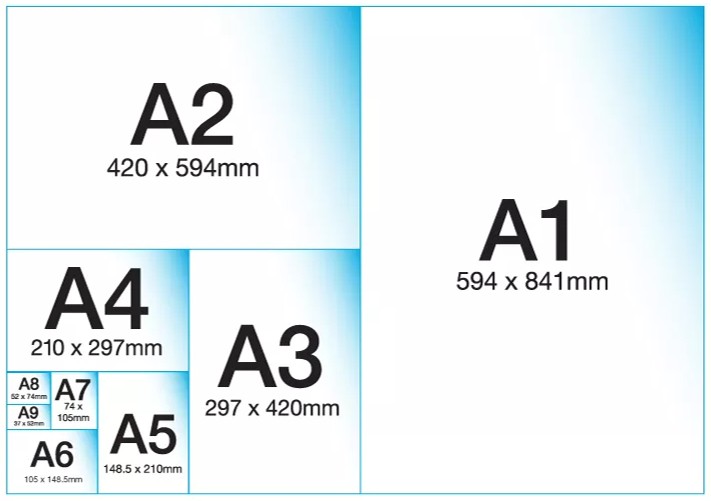
| A Paper Size | Dimensions (inches) | Dimensions (mm) | Area (mm²) | ||||||
|---|---|---|---|---|---|---|---|---|---|
| A0 Size | 33.1 × 46.8 | 841 × 1189 | 999949 | ||||||
| A1 Size | 23.4 × 33.1 | 594 × 841 | 499554 | ||||||
| A2 Size | 16.5 × 23.4 | 420 × 594 | 249480 | ||||||
| A3 Size | 11.7 × 16.5 | 297 × 420 | 124740 | ||||||
| A4 Size | 8.3 × 11.7 | 210 × 297 | 62370 | ||||||
| A5 Size | 5.8 × 8.3 | 148 × 210 | 31080 | ||||||
| A6 Size | 4.1 × 5.8 | 105 × 148 | 15540 | ||||||
| A7 Size | 2.9 × 4.1 | 74 × 105 | 7770 | ||||||
| A8 Size | 2 × 2.9 | 52 × 74 | 3848 | ||||||
| A9 Size | 1.5 × 2 | 37 × 52 | 1924 | ||||||
| A10 Size | 1 × 1.5 | 26 × 37 | 962 | ||||||
| Series A Paper Size Chart Maker : SSize.com | |||||||||
About Series A Paper Size
How are the standard size of A series paper defined?
The standard size of A-series paper is defined by the ISO 216 international standard, which is based on the following key principles:
1. Aspect Ratio:
All A-series paper sizes have an aspect ratio of 1 : √2 (approximately 1 : 1.4142). This unique ratio ensures that when a sheet is cut or folded in half parallel to its shorter side, the resulting halves retain the same aspect ratio.
2. Base Size – A0:
The largest size, A0, is defined to have an area of exactly 1 square meter (1 m²), with dimensions rounded to the nearest millimeter that maintain the 1 : √2 ratio.
Exact theoretical dimensions: Width=841 mm, Height=1189 mm, (841 × 1189 ≈ 1,000,000 mm² = 1 m², and 1189/841 ≈ 1.414 = √2).
3. Subsequent Sizes:
Each subsequent size (A1, A2, A3, etc.) is obtained by halving the preceding size along its longer side:
① A1 = half of A0 → 594 mm × 841 mm
② A2 = half of A1 → 420 mm × 594 mm
③ A3 = half of A2 → 297 mm × 420 mm
④ A4 = half of A3 → 210 mm × 297 mm
... and so on.
This system provides a consistent, scalable set of paper sizes used widely around the world (except primarily in North America). The most commonly used size is A4 (210 mm × 297 mm).
4. Key Advantages of This Standard Paper size.
This design is not arbitrary; it's exceptionally practical:
① Scalability & Consistency: A document can be scaled up or down (e.g., from A4 to A3 for a poster, or to A5 for a booklet) without margins changing or content being cropped.
② Efficient Paper Sizing: Manufacturing paper in large A0 sheets and repeatedly halving them minimizes waste.
③ Standardization: It allows for universal compatibility of printers, copiers, folders, and envelopes. The related B-series (sized as geometric means between A-sizes) is often used for envelopes, ensuring an A4 sheet fits perfectly in a C4 envelope, which fits perfectly in a B4 envelope, etc.
Brand Variation: A "Queen" sheet from one brand might fit a 12" mattress, while another's "Queen" fits only a 10". Always check the pocket depth listing.