Standard Bed Dimensions
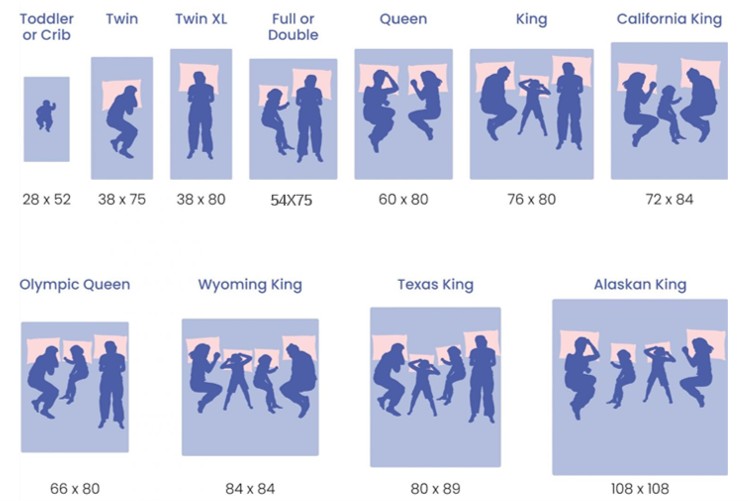
| Bed Dimensions | Size (inches) | Size (cm) | Suitable For |
|---|---|---|---|
| Small Single or Cot | 30 × 75 | 76.2 × 190.5 | Babies and toddlers |
| Twin | 38 × 75 | 96.5 × 190.5 | Kids that have outgrown their cribs and single adults living in smaller apartments. It’s also great for a daybed or bunk bed. |
| Twin XL | 38 × 80 | 96.5 × 203.2 | Kids, taller adults, and those who want to use an adjustable bed frame |
| Full | 54 × 75 | 137.2 × 190.5 | Good for a single sleeper, someone with children or pets, and couples that do not require a lot of legroom. |
| Full XL | 54 × 80 | 137.2 × 203.2 | More than enough for a single sleeper. Also good for couples that need more legroom but can not accommodate queen size due to bedroom limitations. |
| Queen | 60 × 80 | 152.4 × 203.2 | Frequent choice and a perfect size for most couples that do not need a lot of sleeping space. If you plan to sleep alone this is more than enough. |
| Olympic Queen | 66 × 80 | 167.6 × 203.2 | Six Inches wider than a standard queen, it makes it nice for someone who doesn’t want to upgrade all the way to a King. |
| King | 76 × 80 | 193 × 203.2 | Great choice for couples who want maximum personal sleeping space. Check our room dimensions scale guide to ensure it will fit in your bedroom. |
| California King | 72 × 84 | 182.9 × 213.4 | 4 inches longer but 4 inches narrower than a standard king type. Good for taller individuals. |
| Bed Dimensions Maker : SSize.com | |||
About Standard Bed Dimensions
How to choose bed size based on room area and layout?
Choosing the right bed size is crucial for comfort, flow, and the overall feel of your bedroom. Here's a practical, step-by-step guide based on room area and layout.
The Golden Rule: The 2-Foot Perimeter. Aim for at least 2 feet (60cm) of walking space on at least three sides of the bed (especially the sides and foot). This ensures you can move, open drawers, and make the bed comfortably.
Step 1: Measure Your Room.
Draw a floor plan (sketch or digital tool like RoomSketcher).
Record exact dimensions: Width, length, ceiling height (for loft/trundle beds).
Note obstacles: Doors, windows, radiators, vents, closets, and outlets.
Step 2: Prioritize Minimum Clearance Space.
Walking paths: At least 24 inches (61 cm) on sides/foot of the bed.
Door swings: Ensure doors (especially closets/bathrooms) open fully without hitting the bed.
Furniture flow: Account for dressers, nightstands, and seating (aim for 30–36" in front).
Step 3: Choose the dimensions of the bed —— Special Cases & Pro Tips.
A: Small Rooms ( < 10' × 10'): Opt for twin, twin XL, or full.
Use space-saving beds: Loft beds (with desk under), murphy beds, or daybeds. Avoid footboards to maximize space.
B: Narrow Rooms: Place the bed lengthwise against the longest wall.
Choose a low-profile bed frame to create openness.
C: Shared Rooms: Two twins/twin XLs (or bunk beds) save space vs. a queen/king.
Consider a split king if adjustable bases are needed.
D: Primary Bedrooms: Queen or king recommended (if space allows).
Ensure room for nightstands (20–24" wide each) + a bench or seating.
Step 4: Test Your Layout.
Tape it out: Use painter’s tape to mark the bed’s footprint on the floor.
Simulate movement: Walk around, open doors/closets, and "use" imaginary furniture.
Check scale: Leave ⅔ of the floor visible after adding essential furniture.
Step 5: Visual Balance.
Avoid oversized beds: Max ⅔ of wall width for headboards.
Low ceilings? Skip tall headboards/canopies.
Large rooms? Anchor with a king bed + area rug (extending 18–24" beyond bed).